Pergola Curtain Solar Lighting Compared: Soft, Durable Glow
By Rohan Patel • 10th Jun
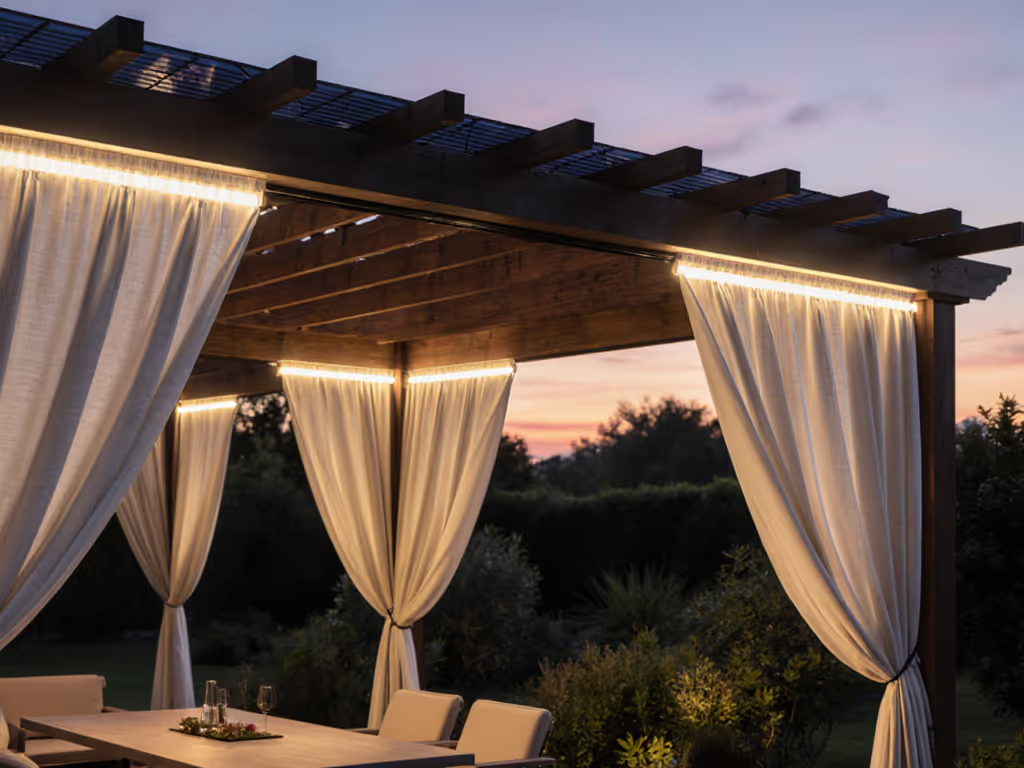
Pergola curtain solar lighting looks effortless - soft fabric, a warm glow, no visible wires - but performance can swing from magical to disappointing depending on how the lights and panels are built and installed. This FAQ deep dive compares pergola curtain solar lighting options, including drapery integrated solar lights, against other draped pergola lighting solutions so you can get a soft, durable glow that still turns on after a few gray days.
Field-tested, not brochure-tested: everything below is based on real-world behavior in shade, rain, and cold, not just spec sheets.
FAQ 1: What exactly is pergola curtain solar lighting?
Pergola curtain solar lighting is any setup where your pergola's vertical surfaces - usually outdoor curtains or privacy panels - carry the light instead of just the roof rafters. For overhead fixtures and mounting tips beyond curtains, see our pergola solar lighting guide.
In practice, that usually means one of three draped pergola lighting solutions:
- Solar curtain light sheets
- Pre-made "curtain" grids of LEDs hanging in vertical strands, powered by a small solar panel and battery pack.
- You hang the LED curtain behind or in place of fabric; the lights themselves form the "curtain."
- Drapery integrated solar lights (fabric + lights)
- LEDs are attached to or sewn along the top tabs, edges, or seams of outdoor curtains.
- A separate solar panel and battery pack powers the LEDs; wiring is hidden in hems or taped along the header.
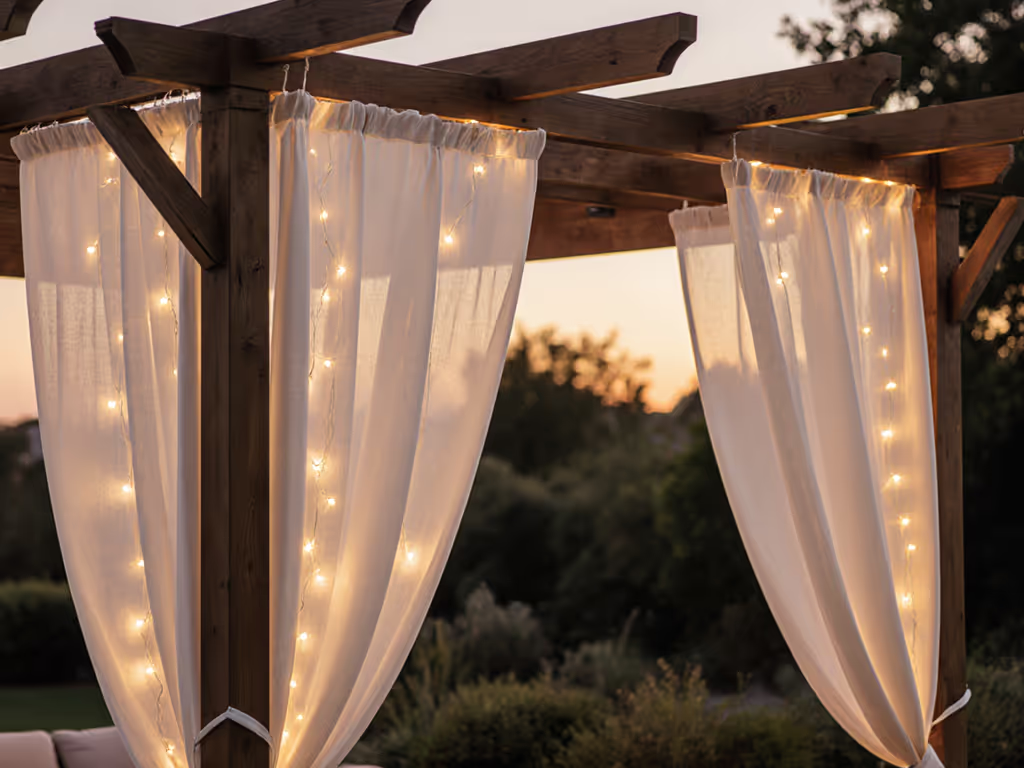
- More rare commercially, but common as DIY using solar string or fairy lights designed for pergolas.
- Emerging solar-light curtain fabrics
- Some solar curtain products embed tiny photovoltaic cells into or behind fabric to collect light and power LEDs in the same panel.
- These work like a self-powered window or pergola curtain: panel and fixture in one unit.
All three aim at soft ambient pergola lighting with minimal wiring, but their real differences show up in brightness, reliability in shade, and winter endurance.
FAQ 2: How do solar curtain lights actually work?
Most solar curtain and drapery-integrated systems share the same core architecture:
- A solar panel (often 1-3 W) converts sunlight to electricity during the day.
- A small battery pack (often 600-2000 mAh) stores that energy.
- At dusk, an onboard controller senses low light and powers the LED curtain in a steady or twinkle mode.
For curtain-style systems, the wiring, LEDs, and sometimes the control electronics are integrated into or behind the curtain itself.
From a measurement standpoint, the bottlenecks are:
- Panel area and orientation - undersized or shaded panels can't fully charge the battery.
- Battery capacity vs. LED load - long, dense curtains with many LEDs drain small batteries quickly.
- Controller settings - nonstop "twinkle" or high-brightness modes shorten runtime.
In my logs, full-size solar curtain sets with realistic panels (more than a postcard-sized cell) and a 1200-1500 mAh Li-ion battery are the minimum to get usable evening runtime in variable weather.
FAQ 3: How does fabric affect brightness and "softness" of the glow?
This is where fabric diffused lighting can either help or hurt you.
What fabric does to the beam:
- A typical sheer outdoor curtain can cut direct LED brightness by 30-60%, but the light that passes through is diffused, eliminating harsh pinpoints and glare.
- A mid-weight, light-colored curtain (cream, light gray) creates a soft panel of light - ideal outdoor curtain illumination for seating zones.
- Dark or heavy fabric can block so much light that even fully-charged solar curtains look dull.
Think in terms of lux at the seating surface, not lumens on the box: If specifications confuse you, this lumens vs watts primer explains lux, color temperature, and IP ratings in plain language.
- Exposed solar string lights: 5-15 lux measured at a nearby tabletop.
- Behind sheer curtains: often 3-8 lux, but more uniform and comfortable.
- Behind medium-weight fabric: 1-4 lux - pleasant mood light, but you may still want separate task lights.
If you like soft ambient pergola lighting, putting solar curtain lights behind sheer fabric is usually worth the loss in raw brightness for the gain in comfort and aesthetics.
For paths and seating, I aim for warm, diffused light in the 2-5 lux range - enough to see faces and furniture edges without creating a runway.
FAQ 4: Will pergola curtain solar lighting work in partial shade and tough weather?
It can, but only if you respect the panel's need for sun and the battery's limits.
Panel placement makes or breaks everything
Guidelines that apply to almost every solar curtain setup:
- Mount the panel where it gets unobstructed sun during peak hours, ideally facing south in the Northern Hemisphere (north in the Southern Hemisphere).
- Avoid deep shade under dense trees, the interior of a solid-roof pergola, or permanent shadows from walls and fences; even partial shading can significantly reduce charging efficiency.
- When possible, mount the panel outside the pergola on a fence or post, then run the cable back to your drapery.
Shadows cast by trees or buildings severely diminish the ability to recharge and reduce brightness and runtime. For placement in tree canopy conditions, see our dappled-shade charging guide covering dappled vs continuous shade.
Weather and winter performance
In my cold-climate tests:
- Many decorative solar curtains deliver 4-6 hours of decent light after a full sunny day in late fall.
- After two overcast days, budget sets often drop to 1-2 hours or fail to turn on at all.
- Lithium-based batteries generally retain more usable capacity in cold than older Ni-MH packs.
If you live in the Pacific Northwest, Upper Midwest, UK, or similar:
- Favor systems with larger external panels over tiny integrated ones.
- Expect to lose 30-50% of rated runtime in winter even with good placement.
- Plan your layout so snow, ice, or roof runoff cannot pool on the panel face.
Tested in shade, counted in storms, kept for real winters - that's the standard I use before I trust a solar curtain system for all-season use.
FAQ 5: How do pergola curtain solar lights compare to other draped pergola lighting solutions?
Here's a side-by-side comparison of common options for draped pergola lighting:
| Solution type | Power source | Brightness & softness | Reliability in shade | Install complexity | Best use case |
|---|---|---|---|---|---|
| Solar curtain lights (no fabric) | Small solar panel + battery | Moderate brightness, visible LED points | Poor in heavy shade without remote panel | Easy: hang and connect | Decorative waterfall effect, perimeter glow |
| Drapery integrated solar lights | External solar panel + battery | Softer, fabric-diffused light; less glare | Fair to good if panel mounted in sun | Moderate: curtains + wiring | Cozy seating areas, rentals, HOA-friendly |
| Solar string/fairy lights on curtains | Small solar panel + battery | Flexible; can run along edges or headers | Similar to above; depends on panel placement | DIY-friendly | Budget-friendly, customizable patterns |
| Low-voltage (12V) LED on curtains | Transformer, mains-powered | Bright, stable, dimmable; can be very soft with diffusers | Excellent regardless of shade | Higher: wiring, transformer, often pro install | Year-round primary lighting, task+ambient mix |
If you want grid-free, low-maintenance ambiance, drapery integrated solar lights and solar string lights on curtains are the sweet spot. For primary lighting or seriously shaded pergolas, low-voltage systems win on consistency.
FAQ 6: What color temperature and mode should I choose for a soft, neighbor-friendly glow?
For pergolas, I won't recommend anything above 3000K.
- 2700-3000K: warm, candle-adjacent, flattering to skin tones and wood grain; ideal for soft ambient pergola lighting.
- "Cool white" or "daylight" solar curtains often look harsh and highlight fabric wrinkles instead of creating a welcoming wash.
Mode tips:
- Use steady-on for everyday evening use.
- Reserve twinkle or wave modes for short events; constant motion is distracting and can feel cluttered behind drapes.
- Keep brightness at the lowest setting that still lets you navigate safely - this preserves battery life and keeps you on good terms with neighbors and wildlife.
Dark-sky and HOA rules typically favor shielded, warm light with minimal upward or outward spill. With curtains, the fabric itself becomes a diffuser and shield, which is an advantage over bare bulbs.
FAQ 7: How many solar curtain panels do I actually need for my pergola?
Here's a practical sizing approach I use in the field.
- Measure your span
- Example: a 10 ft (3 m) pergola side with two curtain panels.
- Check the LED spacing and width
- Many solar curtain light sets cover 6-10 ft in width with vertical strands spaced 4-6 in apart.
- Decide your goal
- Soft glow only: 1 curtain set for 8-10 ft is usually enough.
- More drama or visual impact: 1 set per 6-8 ft, or overlap two sets.
- Account for fabric
- If placing the lights behind curtains, assume you'll need about 25-50% more LED density than if they were exposed, depending on fabric thickness.
If you're lighting multiple sides, start with one lit side, live with it for a few nights, and then decide whether you need more. It's easier to add a second set than to live with an overlit, busy pergola.
FAQ 8: What should I look for to judge durability and weather resistance?
Marketing language here is notoriously optimistic, so I focus on a few measurable clues:
-
Panel and housing quality
-
Solid-feeling panel frame, gasketed seams, and stainless screws resist water intrusion and corrosion in rain and freeze-thaw cycles.
-
Avoid panels that flex easily or feel hollow.
-
Ingress protection (IP) rating
-
Aim for IP65 or higher for exposed panels and junction boxes - this indicates protection from water jets and dust.
-
UV-stable materials
-
Look for UV-stabilized plastics or powder-coated metal hardware, especially at curtain hooks, clips, and tie-backs.
-
Replaceable battery
-
A battery compartment you can open with a screwdriver extends life significantly; permanent-sealed pouches often fail after 2-3 seasons.
Routine care helps: cleaning the panel face with a damp microfiber cloth a couple of times a year keeps dust, pollen, or salt spray from cutting charging efficiency.
In my logs, the systems that survive winters are usually the ones with:
- Sturdy, gasketed panel housings.
- Simple, replaceable 18650-type batteries.
- Modest LED counts relative to battery size, instead of trying to push hundreds of LEDs from a tiny cell.
FAQ 9: What are the most common mistakes people make with pergola curtain solar lighting?
I see the same failure patterns over and over:
- Panel buried in shade
- Mounted inside the pergola or under an eave where direct sun almost never hits.
- Overloading one small panel
- Trying to drive long, dense curtain sets from a tiny panel; looks great night one, disappointing by night three.
- Ignoring color temperature
- Mixing cool-white curtain lights with warm path or deck lights, creating a patchwork look.
- Using heavy or dark curtains with weak lights
- The fabric absorbs most of the light, leaving only a faint glow.
- Never testing in bad weather
- Everything seems fine in summer; the first week of rain and early sunsets reveals the system can't keep up.
If your pergola is shaded more than 40-50% of the day, treat "fully solar and fully reliable year-round" as an engineering challenge, not a given.
FAQ 10: Should I choose solar curtain sheets or drapery integrated solar lights?
Both can work well; the right choice depends on your priorities.
Choose solar curtain light sheets if:
- You want a visible "waterfall" of lights as the main feature.
- You're okay with a slightly more decorative, less subtle look.
- You have at least one good, sunny mounting spot for the panel.
Choose drapery integrated solar lights (or solar strings on curtains) if:
- You want fabric diffused lighting with fewer visible LEDs and more of a glowing wall effect.
- You care about glare-free, dark-sky-friendly ambiance.
- You can mount the panel outside the pergola in a sunnier spot and run a cable back.
In my own shaded tests, drapery integrated setups with a remotely mounted panel survive bad weather better than compact, all-in-one curtain panels stuck in the pergola's shadow.
FAQ 11: How can I "test before I commit" without rewiring the whole pergola?
Here's a simple, measurement-first approach:
- Mock up one bay
- Install a single solar curtain set or a single run of drapery integrated lights on one side of the pergola.
- Track three basic metrics for a week
- Sun exposure: note how many hours the panel sees direct sun.
- On-time: note when the lights turn on and when they shut off.
- Perceived brightness: can you clearly see chair edges, steps, and table surfaces?
- Test in bad conditions
- Don't just evaluate on clear nights; note performance after two cloudy days or a storm.
- Adjust and scale
- If runtime is short, move the panel, reduce twinkle modes, or accept that you may need a larger or additional panel before repeating the layout on all sides.
This small experiment mirrors how I test: one corner, real weather, honest logs. If a system passes there, I'm comfortable recommending you scale it up. For a full framework, use our garden solar light testing guide to track metrics and compare setups.
Where to go from here (Further Exploration)
If your goal is a pergola that feels like a warm, quiet room at night - not a theme park - start with one thoughtfully placed run of drapery integrated solar lights behind light-colored outdoor curtains, in the 2700-3000K range. Give it a week in your actual weather, observe how long it runs after cloudy days, and adjust panel placement before committing to the entire structure.
From there, you can explore:
- Adding a second, separately switched layer of low-voltage task lighting for dining or grilling.
- Experimenting with different fabric weights to dial in how much diffusion you like.
- Logging simple metrics (on-time, sun hours, rough lux estimation with a phone app) to compare different draped pergola lighting solutions on your own terms.
Tested in shade, counted in storms, kept for real winters - that's the standard that turns pergola curtain solar lighting from a short-lived decoration into a reliable part of your outdoor room.
Related Articles