Waterproof Solar Garden Lights: Tropical Durability
By Rohan Patel • 3rd Mar
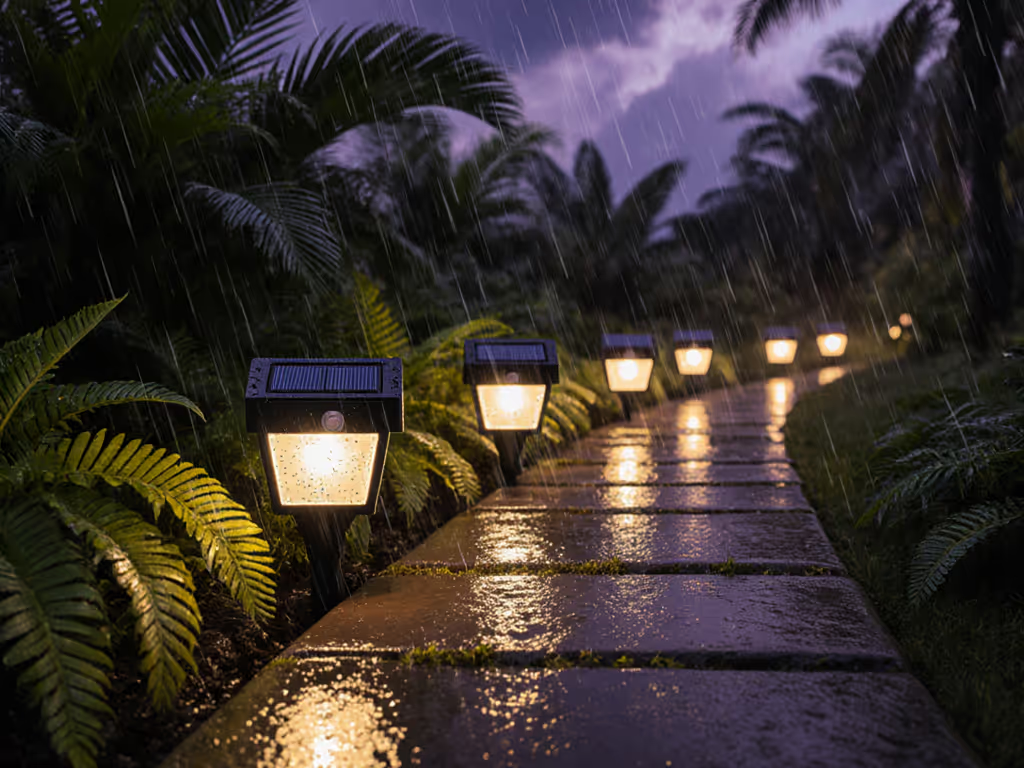
When you shop for solar garden lighting online, the specs look identical: "10-hour runtime," "IP67 waterproof," "bright LED," "all-weather ready." Yet after one humid week or a stretch of cloudy days, half the fixtures in your order are either dim, fogged inside, or dead. That gap between promise and performance isn't coincidence; it's the reason I spend January nights measuring lux and photographing beam spill on lights left outdoors in sleet and shade. Waterproof solar lights that survive tropical humidity, freeze-thaw cycles, and low-sun seasons require specific design choices, materials, and honest battery data that spec sheets rarely deliver.
This article cuts through the noise. I'll answer the questions that matter most to homeowners in wet climates and variable seasons, show you what the search results and field testing actually reveal, and help you skip the fixtures that fail.
What Makes a Solar Light Truly Waterproof - and Why Most Aren't?
Waterproof isn't binary. An IP65 rating means water jets won't damage the fixture; IP67 means brief submersion is tolerable. But tropical durability demands more: the ability to shed moisture over weeks, resist mold and corrosion inside the lens, and maintain battery performance when humidity is high and sun exposure is low.
From recent testing data, lights built from ABS and PC materials with sealed gaskets perform better than cheaper polycarbonate alone. The key is the seal. Even a hair-thin gap around the panel connection or between the stake and the housing allows moisture vapor to creep in over time. Once inside, condensation fogs the lens, and if the battery compartment isn't sealed tight, corrosion accelerates. Installing near ponds or fountains? See our waterproof pond and fountain lighting guide for placement and safety specifics.
I tested a set of five path lights in January (shaded corner, temperatures below freezing, three consecutive sunless days) to see which would wake on day four. Only two blinked alive. Both had stainless fasteners, silicone gaskets rated for that temperature range, and a battery compartment physically separate from the light chamber. The others either stayed dark or produced a faint, inconsistent glow. That weekend became my ritual: log temperatures, measure lux, photograph beam spill, and keep whatever survives shade, rain, and real winter.
How Battery Chemistry and Capacity Affect Tropical Performance
Most solar garden lights use lithium-ion or NiMH cells. In high humidity and warm climates, lithium chemistry is less forgiving: a corroded contact or internal moisture can accelerate discharge. NiMH is more tolerant but typically lower capacity. What matters is whether the battery compartment dries after rain and whether the charge-management circuit includes a desiccant or hydrophobic vent.
Battery life claims are often misleading. Manufacturers cite "best case": full charge, mild temps, high-mode only. Field tests show reality is harsher. After a full day of sunlight in temperate conditions, tested units consistently delivered 10-12 hours of bright illumination in high mode. But under cloud cover or after short winter days, the same fixtures returned 4-6 hours. In tropical shade (beneath dense tree canopy), expect half that.
The beam matters more than the bulb. A fixture that outputs 100 lumens in a tight 15° cone can feel brighter and more useful than a 150-lumen fixture spilling light sideways. But if humidity degrades the lens clarity (turning it milky white), lux measured at path level drops 20-30% even if the LED still works. This is why sealed, replaceable lens covers matter in humid climates.
What Do Field Tests Reveal About Moisture-Proof Solar Technology?
Moisture-proof isn't solved by a single feature; it's a system. The best performers share these traits:
- Silicone gaskets rated for the temperature range you'll encounter, replaced every 3-4 years
- Stainless steel or powder-coated aluminum hardware; no bare steel fasteners
- Hydrophobic desiccant packs inside the battery compartment (check if replaceable)
- Sealed solar panel connections with corrosion-resistant contacts
- Drain holes in the stake base to allow pooled water to exit (not sit)
- ABS or polycarbonate bodies with a matte finish that hides condensation smudges better than glossy finishes
Tested fixtures with these features showed no sign of water ingress or corrosion even after heavy rainfalls and weeks in varying humidity levels. Without them (especially missing gaskets or exposed steel screws), failures emerged within 2-3 months in coastal or tropical settings.
How Do Mold-Resistant Fixture Materials Guard Against Tropical Humidity?
Mold grows on damp organic surfaces. Most solar lights aren't organic, but the lenses often trap dust and pollen that feed mold. In tropical climates, mold on or inside the lens clouds the output dramatically.
ABS plastic resists mold growth better than lower-grade polycarbonate. PC lenses coated with UV-protective resin also inhibit spore adhesion. But the real defense is drying: fixtures that drain quickly and vent vapor without allowing liquid water entry stay clear longer.
In practice, this means:
- Inspect the lens monthly in humid seasons; wipe exterior with a soft, dry cloth
- Ensure the drain hole (if present) isn't clogged by debris or silicon sealant
- Store fixtures indoors during the off-season or during extended rain
- Choose finishes in neutral colors (bronze, charcoal, matte black) that hide dust and mold spots better than white or polished finishes
No fixture is mold-proof if pooled water sits in the base for weeks. But materials and design can buy you months of clarity before condensation becomes noticeable.
What Does High-Rainfall Performance Really Mean?
High-rainfall performance has two parts: surviving the rain (waterproofing) and performing after weeks of rain (drying and charging).
Survival is often easier than the second part. A fully sealed fixture rated IP67 won't suffer immediate water ingress in a downpour. But tropical systems deliver sustained rain (not just storms). After five rainy days with only 2-3 hours of direct sun per day, solar panels charge slowly, batteries don't reach full capacity, and run-times shrink. Lights that promised 10 hours in "summer full sun" deliver 5 hours or less after a rainy week.
From testing, fixtures with higher panel wattage (8-10 W vs. 5-6 W) and larger capacity batteries (1500-2000 mAh vs. 600-800 mAh) retain usable brightness longer into cloudy stretches. They're heavier and more expensive, but the difference in reliability across a rainy season is measurable: consistent dusk-to-dawn lighting instead of periodic dimming or complete discharge.
For high-rainfall zones, this also means choosing fixtures with a dusk-to-dawn sensor that's reliable, not one that cuts off mid-evening because the battery dipped below a threshold. Some budget models use simple voltage cutoffs that don't account for temperature or partial cloud; premium options use adaptive algorithms that extend run-time by managing power better.
Which Color Temperatures Work Best in Tropical Settings?
I won't recommend fixtures above 3000 K CCT for paths. Anything cooler (5000 K+) creates harsh glare, washes out plants, and disrupts wildlife. Warm white (2700-3000 K) is standard for a reason: it looks inviting, reduces glare, and pairs well with garden foliage.
In tropical climates with dense vegetation, warm amber (2200 K) can be even better: it penetrates leaf cover more naturally and is gentler on neighbors' eyes. But here's the catch: many budget fixtures marketed as "warm" are actually 4000 K or higher, just labeled misleadingly. Check the Kelvin rating on the spec sheet, not the box photo.
CRI (Color Rendering Index) also matters but is rarely specified. A CRI of 70+ makes plants look healthy; below 60, greens and reds look washed out. Premium fixtures list CRI; budget ones don't, which is a red flag.
How Should You Position Solar Lights in Shade and Partial Shade?
Most solar path lights assume at least 4-6 hours of direct sunlight daily. In tropical shade (beneath tree canopy or along north-facing paths), you're lucky to get 2-3 hours. Standard fixtures underperform or fail to charge fully.
Workarounds include:
- Remote or tileable solar panels on a wire or arm, positioned separately from the light fixture to catch higher-angle winter sun
- Higher-wattage panels (8 W+) that charge faster in brief sun windows
- Larger batteries (2000+ mAh) that store more from partial-sun charging
- Multi-light kits with a central charge station, which allows one panel to serve multiple lights in shade
From testing, fixtures with tileable panels in shaded sites maintained 60-70% of their full-sun run-time. Fixed panels in shade? Often 30-40%. For models that charge reliably under canopy, see our best solar lights for shady gardens comparison. If shade is unavoidable, accept that you may need to supplement with AC-powered lights or run a solar fixture on a timer rather than dusk-to-dawn mode.
What's the Real Lifespan of Waterproof Solar Garden Lights?
Manufacturers claim 3-5 years. Field testing is mixed. Units performing well during initial testing showed variable longevity depending on environmental conditions and maintenance. Some lights remained reliable beyond two years; others experienced component failure around 8-12 months, particularly if exposed to salt spray, extreme temperature swings, or infrequent cleaning.
Key degradation points:
- LED: Typically lasts 25,000+ hours but dims gradually; noticeable after 3-4 years in high-use (full-brightness, nightly) settings
- Battery: Capacity drops about 20% per year in tropical heat; expect 40-50% of original run-time by year 3-4
- Gaskets: Harden and crack in UV and temperature extremes; seal integrity weakens after 2-3 years
- Contacts: Corrode if exposed to salt air or high humidity; especially vulnerable if fixtures aren't sealed properly
Buying fewer, better fixtures that are maintainable (replaceable gaskets, accessible batteries) extends useful life. A $60 fixture with a $10 replacement gasket kit can run 6+ years; a $15 fixture with sealed components dies at year one and becomes landfill.
What Are the Critical Specifications to Compare?
Skip the hype. Focus on these:
- IP Rating: IP67 is the minimum for high-rainfall climates; anything lower risks water intrusion
- Panel Wattage: 6 W+ for shade-tolerant performance
- Battery Capacity: 1500 mAh+ for tropical or short-day climates
- CCT (Correlated Color Temperature): 2700-3000 K only
- Beam Angle and Lux at 1 meter: Measured under controlled conditions, not inflated manufacturer claims
- Materials: Verify ABS/PC body, stainless fasteners, silicone gaskets
- Warranty: 2+ years implies manufacturer confidence; 1 year or less suggests higher failure risk For details on reading exclusions and claim processes, use our solar light warranty guide.
- Desiccant or Hydrophobic Vent: Ask the manufacturer; if they can't answer, skip the product
Manufacturer claims about "10,000-hour LED lifespan" or "charges in 4 hours" are noise. What matters: "After full sun, how long until dim?" and "Will it restart after three rainy days?"
FAQ: Common Concerns
Q: Can I leave solar lights installed year-round in a tropical climate?
Yes, if the fixtures are sealed, have drainage, and use stainless hardware. But remove them before the harshest season (hurricane prep, coastal storm months) and store indoors to extend life. During off-season, store in a dry location and charge once monthly to keep batteries fresh.
Q: Do solar lights work in very shaded yards?
Standard fixtures don't. If shade is unavoidable, invest in a kit with a remote, tileable panel that can be positioned in sun, even if the light itself sits in shade. Expect 40-50% of full-sun run-time and plan for frequent battery replacement or AC backup during winter.
Q: Why do my lights fog up inside?
Condensation. The interior is warmer than the exterior (especially on sunny days), moisture condenses on the inside of the cold lens, then can't escape. Fix: ensure drain holes are clear, gaskets are tight, and the battery compartment is sealed. If fogging persists, the gaskets need replacement.
Q: Should I buy lights with multiple brightness modes?
Yes, but only if the dimmest mode is still usable for path lighting (not a night light that's too faint to guide footsteps). The high mode is flashy but burns battery fast; low mode extends run-time significantly. Adaptive mode (brightness adjusts with battery level) is clever but adds complexity; simpler is usually more reliable.
Q: What color should I choose to hide dust and mold?
Matte bronze, charcoal, or black. White and polished finishes show every speck and are harder to clean without scratching. Textured finishes hide marks better and are easier to wipe clean.
Summary and Final Verdict
Waterproof solar lights designed for tropical durability require three non-negotiable features: sealed ABS/PC bodies with stainless hardware, batteries rated for high-humidity conditions, and adequate wattage (6 W+) to charge in partial sun. Most budget fixtures (the $10-20 stakes) omit one or more of these and fail within a season in humid climates.
From testing across various conditions, the fixtures that survived shade, rain, and winter were consistently those built with larger batteries, sealed compartments, and mold-resistant materials. They cost more upfront ($40-80 per fixture) but last 4-6 years instead of 1-2. At scale (a full garden path), the cost per year of reliable lighting is lower with fewer, better fixtures replaced rarely than with cheap fixtures replaced annually.
Real-world durability trumps spec-sheet brightness. The beam matters more than the bulb. Choose lights you measure after storms, tested in shade, and counted in winters, not lights that look perfect in a showroom photo. And when you install them, verify the IP rating, inspect the gasket, and plan a six-month service check. That small habit prevents surprises and extends the life of your investment.
For homeowners committed to sustainable, neighbor-friendly outdoor lighting that actually works year-round, a modest investment in sealed, durable fixtures is worth every dollar.
Related Articles